Coral Castle remains a fascinating enigma, shrouded in mystery and beauty. Originally known as “Rock Gate,” this impressive structure was single-handedly built by Edward Leedskalnin, a man of modest education and frail health, reportedly due to tuberculosis. What’s astounding is that Ed accomplished this feat without assistance or modern machinery, relying solely on his ingenuity and unwavering determination.
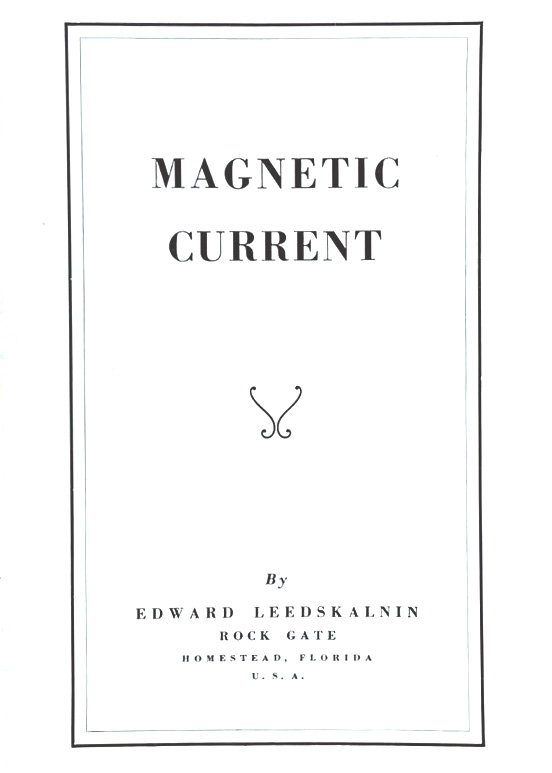
Following two years of rigorous experimentation with magnets, self-taught engineer Edward Leedskalnin presents his groundbreaking theories on magnetism in Magnetic Current.
Ed’s passion for learning extended beyond his formal education, driving him to delve into magnetism, electricity, and physics. He authored, copyrighted, and published several books, that provides insightful explanations of magnetic fields, electrical currents, and practical applications. In his writings, Ed explains the fundamental phenomenon of magnetism, stemming from magnetic fields, which induces attraction between objects and magnets. This phenomenon generates circulating currents within metal objects, characterized by opposing north and south poles. Ed emphasizes the remarkable indestructibility of magnets, and that presence of magnetism is everywhere, pointing out that everything relying on electricity or motors utilizes magnets – even the Earth itself, with its magnetic field safeguarding the planet from solar winds. In Ed’s unique understanding and interpretation of magnetism and the natural world, he writes, “The North and South pole individual magnets are the cosmic force. They are the building blocks of nature’s perpetual transformation of matter, and they are so small that they can pass through everything. They pass through earth from pole to pole, and around the earth.”
Bottles and glass insulator remains wrapped in wire found during an on-site excavation.
Ed’s extensive study of magnetism enabled him to design several experiments to test his theory of harnessing the power of magnetic current to create perpetual motion.
Ed was also interested in radio technology and built his own crystal radio using reclaimed parts. He wrapped glass bottles in wire to create a radio frequency coil, so he could listen to short wave radio without electricity. Several of these bottles are on display in Ed’s Tool room.
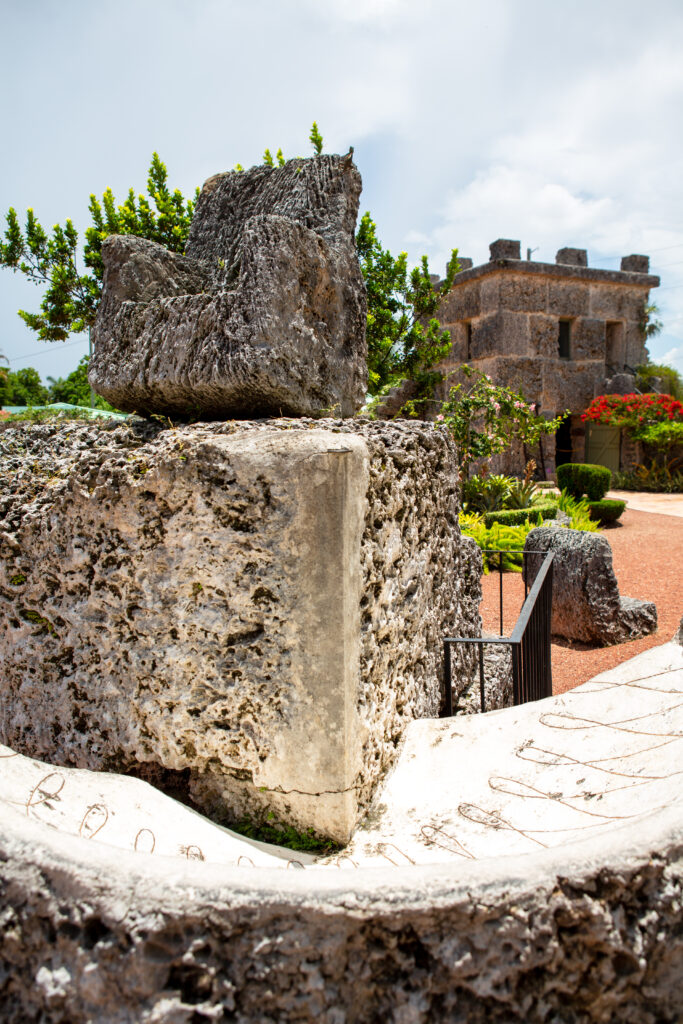
Ed's unique Sundial stands alone worldwide in its ability to display the time of day, month, year, and the four seasons, including the equinox and the solstices.
Ed’s passion for learning extended beyond his formal education, driving him to delve into magnetism, electricity, and physics. He authored, copyrighted, and published several books, that provides insightful explanations of magnetic fields, electrical currents, and practical applications. In his writings, Ed explains the fundamental phenomenon of magnetism, stemming from magnetic fields, which induces attraction between objects and magnets. This phenomenon generates circulating currents within metal objects, characterized by opposing north and south poles. Ed emphasizes the remarkable indestructibility of magnets, and that presence of magnetism is everywhere, pointing out that everything relying on electricity or motors utilizes magnets – even the Earth itself, with its magnetic field safeguarding the planet from solar winds. In Ed’s unique understanding and interpretation of magnetism and the natural world, he writes, “The North and South pole individual magnets are the cosmic force. They are the building blocks of nature’s perpetual transformation of matter, and they are so small that they can pass through everything. They pass through earth from pole to pole, and around the earth.”
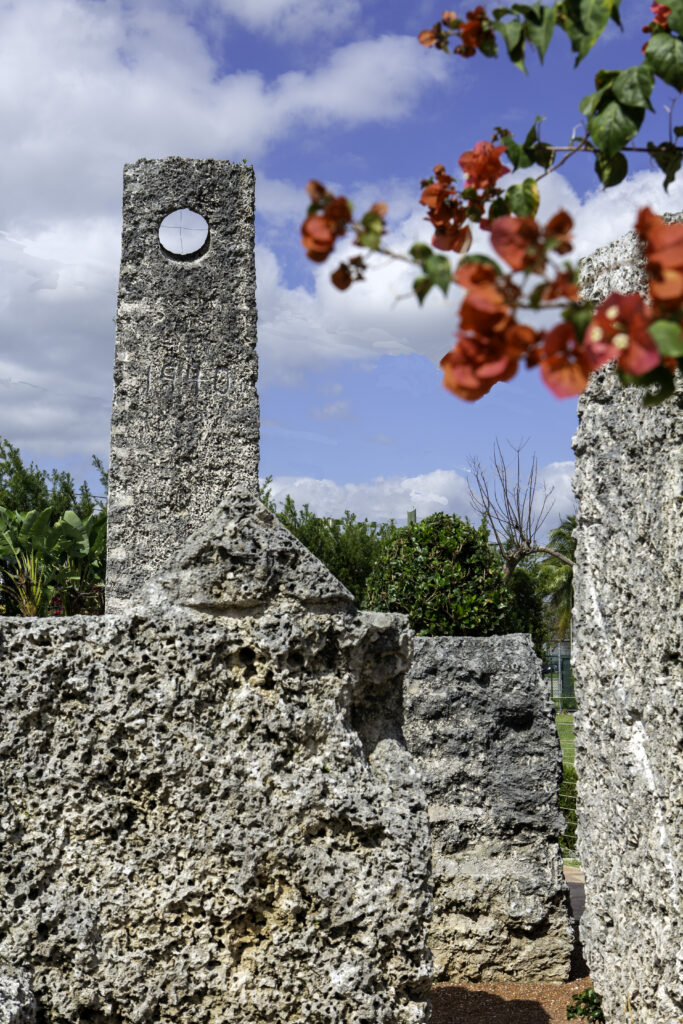
The Polaris Telescope.
Another impressive structure is the Polaris Telescope, which Ed carved in two separate pieces. Inside the north wall stands the first stone structure, housing the eyepiece. A perfectly bored hole through the stone which aligns with the aperture of the second structure, 25 feet away.
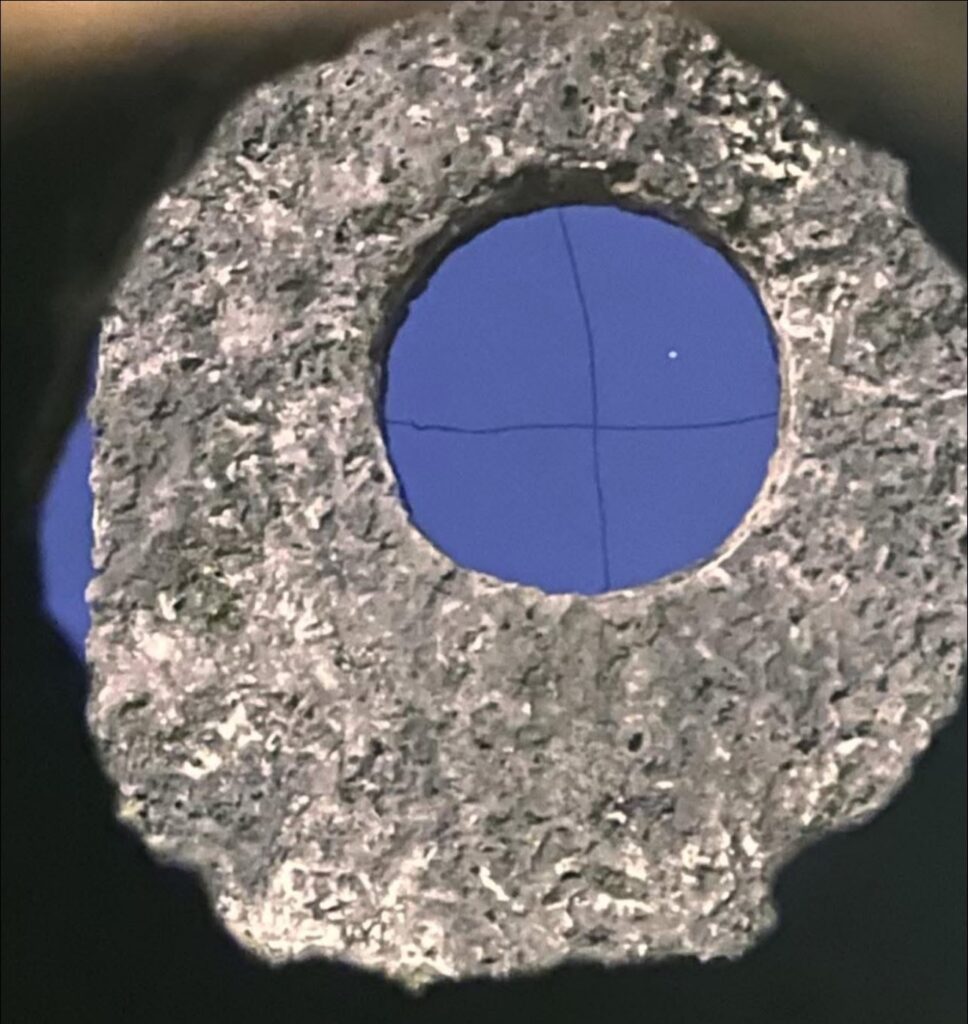
Atop this towering 25-foot, 20-ton monolith, is a precision-crafted hole that features metal crosshairs, reminiscent of a rifle scope. Each quadrant represents a season of the year. Gazing upward at a 25-degree angle, on a clear Florida night sky, you will always see the North Star.
Telescope looking through the eyepiece at the North Star.
The star will be positioned in one of the quadrants that represents the season of the year and will move within the circle of the telescope as the year progresses.
The Polaris Telescope showcases Ed’s ingenuity, master craftsmanship, and passion for astronomy, earning its reputation as one of the world’s most unique structures of its kind.
It is well documented that Ed did not use modern machinery or technology of any kind.
So, the question remains: how did he achieve such precision alignment without the aid of electrical equipment or technological tools?
Bore hole found on the south wall.
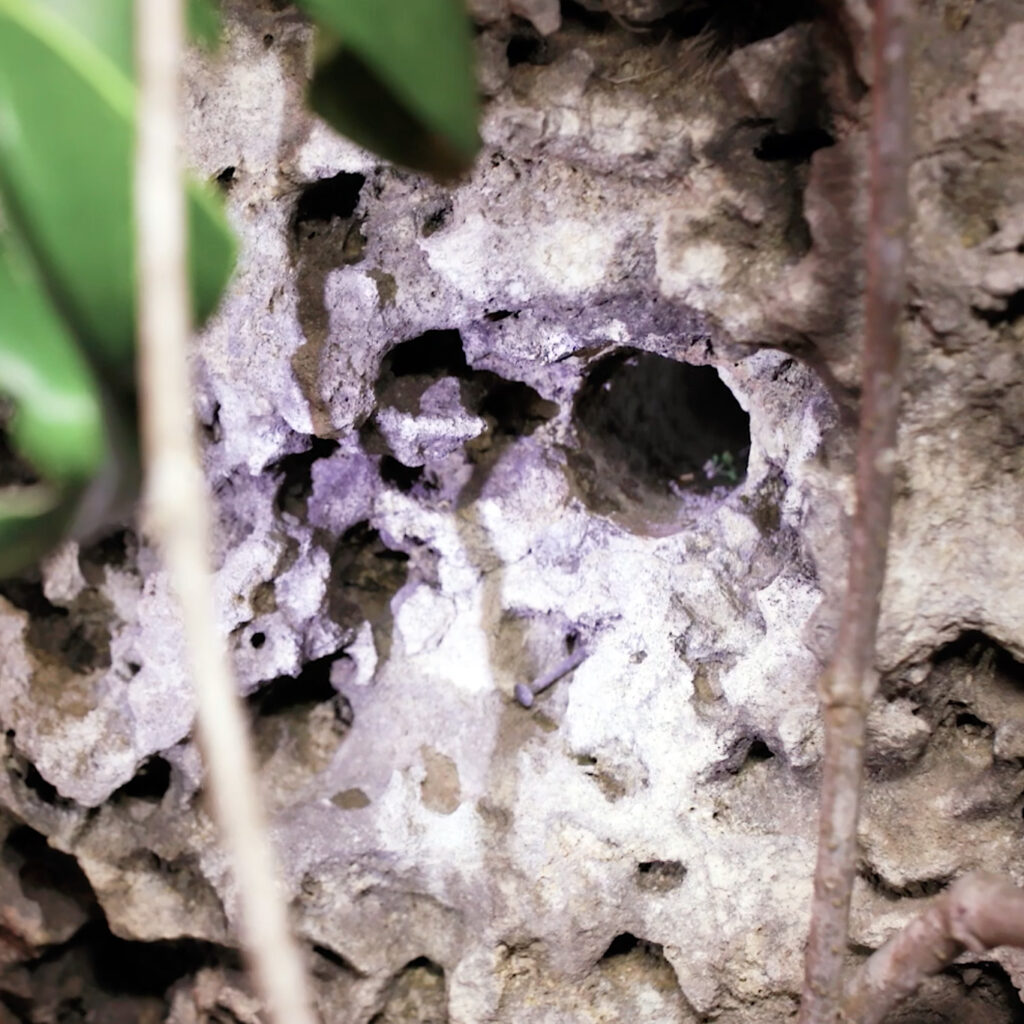
Throughout the castle, numerous stone blocks feature perfectly bored holes, sparking curiosity about Ed’s methods. A recent experiment using laser beams shed light on this mystery. By carefully positioning lasers in each hole, we discovered the holes formed perfect triangles, which correlated and connected one structure to another. This formulation was eerily reminiscent of those created using the Pythagorean theorem. This ancient mathematical concept, famously attributed to the Greek philosopher Pythagoras, was also well-known to ancient Babylonian and Egyptian mathematicians.
The Pythagorean theorem has its roots in ancient cultures, with evidence indicating that early civilizations such as the Chinese, Mayans, Indians, and Egyptians used this mathematical concept to design and construct monumental buildings and pyramids. Before GPS, Pythagorean theorem was the go-to method for ensuring accurate alignments and layouts in architecture and surveying.
Ed’s own architectural achievement similarly hints at the influence of this mathematical concept, as he expertly constructed and aligned massive stones with precision. His ingenuity and resourcefulness were instrumental in merging ancient wisdom with innovative techniques, to create these remarkable structures.
Cookie Consent
We use cookies to improve your experience on our site. By using our site, you consent to cookies.